

How to Overcome a Creative Block? Strategic Techniques to Generate Ideas
In the daily life of brands, entrepreneurs, and creative teams, mental block appears as a silent enemy. Many times, you know you need a big idea a different message, a disruptive campaign but you don’t know where to start. Having a repertoire of techniques to activate creativity is key to avoiding dependence on sudden inspiration and achieving consistent innovation. In this article, we’ll show you concrete tools, based on reliable sources and real experiences, so you’ll never lack ideas when you need them most.
Understanding Creativity as a Process
It’s not divine inspiration, it’s intelligent combination. A creative idea doesn’t appear out of nowhere: it emerges from connecting elements that weren’t previously linked, from exploring less obvious connections. It’s an iterative process that combines exploration (divergent thinking) and refinement (convergent thinking).
For example, imagine a local fast-food restaurant that decides to break the mold: instead of competing with more menus or combos, it launches a “silent hour.” For 30 minutes a day, no music is played, no conversation is encouraged, the restaurant creates an environment of absolute silence so diners “listen” to their food: chewing, crunching, serving. That idea goes beyond the product: it transforms the sensory experience. This kind of idea arises when you ask: “How can I challenge the restaurant experience? Why is there always noise in fast food places?” and use techniques to explore those questions.
From Blank Page to Brainstorm
Concept Cloud (or association cloud)
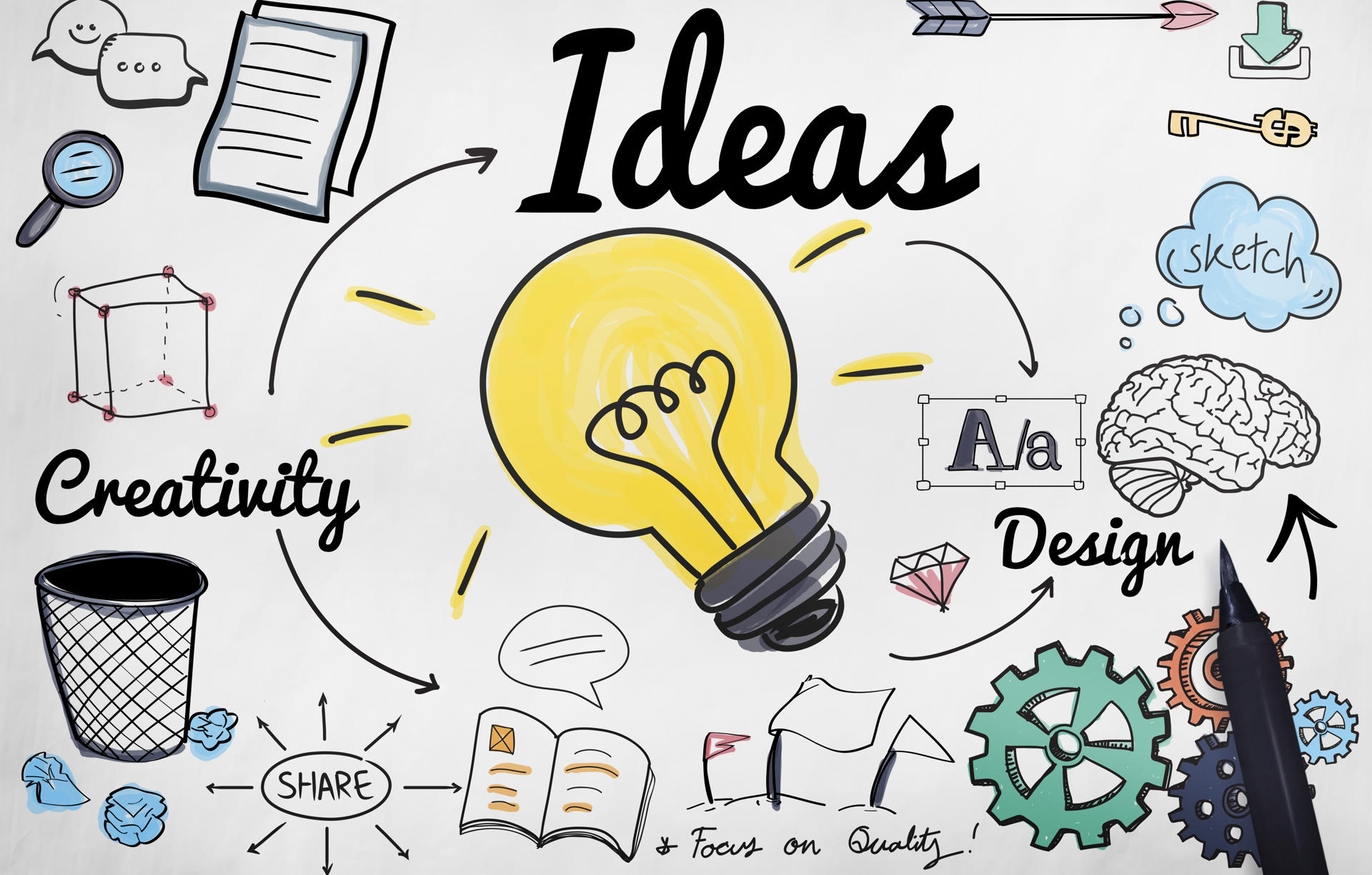
It consists of placing the key topic (or problem) in the center of a sheet and surrounding it with words, concepts, associated images in the form of a cloud. Then those associations continue to branch out, seeking unsuspected connections. This technique is a variant of mind maps/visual adaptations that many creative thinking methods recommend as an idea facilitator. (concept cloud).
The advantage of the concept cloud is that it opens visual and semantic routes that the logical mind often does not initially see.
Five Whys Technique
It consists of taking a phenomenon, challenge, or problem and asking “why?” repeatedly (five times or until reaching the core). This technique helps to deepen root causes and imagine more original solutions. For example, if a campaign does not gain traction:
- Why doesn’t it gain traction? Because it does not connect with a powerful emotion.
- Why doesn’t it connect with emotion? Because the message is generic.
- Why is it generic? Because we did not express a real audience tension.
- Why didn’t we express that tension? Because we did not research it well.
- Why didn’t we research it? Because we did not integrate users into ideation.
Thus, you arrive at the conclusion that perhaps you need to create co-creation workshops with users to detect real tensions. This technique is used in root cause analysis and in strategic innovation. (Five Whys).
Brainwriting
A team technique consists of each participant writing ideas on a sheet (or post-it). Then, after a period of time, they exchange the sheets with other members, who add new ideas or comment on those they received. That exchange makes it possible to build on what someone else has already written, avoiding individual blockages. This technique is recommended because it reduces verbal dominance and allows shy ideas to emerge. (Brainwriting).
SCAMPER Technique
SCAMPER is a structured method that helps generate innovative ideas from an already existing concept. Its name comes from the initials in English of seven action verbs that invite you to look at a product, service, or process from different angles:
- S (Substitute) → Substitute: what would happen if I change a material, a channel, a color, an ingredient?
- C (Combine) → Combine: what results would emerge if I unite two products, services, or messages?
- A (Adapt) → Adapt: how can I apply something that works in another industry to my case?
- M (Modify) → Modify: what if I change the shape, size, presentation, duration?
- P (Put to other uses) → Put to other uses: can it serve another audience or purpose different from the original?
- E (Eliminate) → Eliminate: what happens if I remove a part of the product, a function, or an unnecessary step?
- R (Rearrange/Reverse) → Rearrange/Reverse: what happens if I invert the sequence, the order, or the logic of the process?
This technique pushes you to challenge inertia, opens multiple perspectives, and ensures that you do not stay with the first idea, but rather explore creative variations until you arrive at more original and useful solutions. (SCAMPER)
Systematizing creativity strengthens you
The big challenge is not to have a brilliant idea, but to generate many quality ones, iterate them, and choose well. These techniques help you not to get stuck, to involve diversity in thinking, and to structure creativity. Those who master these tools no longer wait for the muse: they create it.
This article is a manual of actions that any person, team, or entrepreneur can adopt. The idea is that, from your brand or team, you can activate these methods internally, daily, so that idea generation ceases to be a chance moment and becomes a systematic and sustainable practice.
Activate your creative method
Creativity is not a mystical trait: it is a skill that can be cultivated with techniques. Concept clouds, the Five Whys, brainwriting, SCAMPER are concrete, effective, and practicable tools to activate your imagination when you need it most. Combining them intelligently allows you to open new routes, deepen meanings, and build relevant ideas.